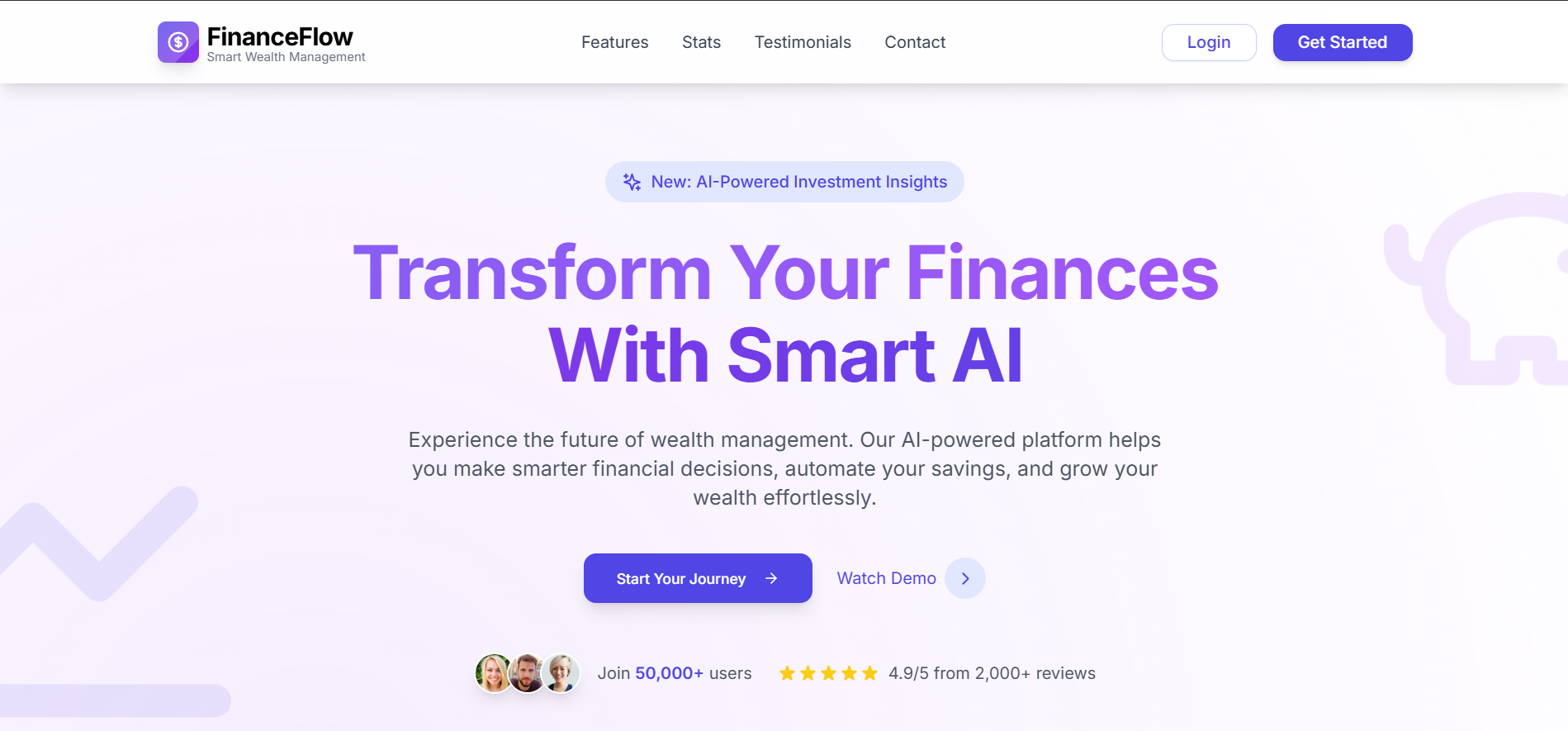
FinanceFlow
A holistic wealth management platform combining AI-driven financial insights with the security of blockchain technology.
Tech Stack
Languages
 Javascript
 Python
 Typescript
 Solidity
Tools and Workflow
 Git
Git GitHub
 Postman
Web Development
 Express.js
 Next.js
 Node.js
 Tailwind
Database Design
 PostgreSQL
🚀 Overview
FinanceFlow is an end-to-end financial management platform that combines modern web technologies, artificial intelligence, and blockchain to deliver intelligent, transparent, and secure personal finance management. Built across four interconnected repositories, the system solves the fragmentation problem in fintech—users typically juggle separate apps for budgeting, investment tracking, and transaction settlement. FinanceFlow unifies these into a single, intelligent platform where AI-driven insights guide decisions and blockchain ensures transaction immutability. It's designed for financially-conscious individuals and enterprises seeking transparent, data-driven financial management with decentralized settlement options.
✨ Key Features
- Unified Financial Dashboard: Centralized view of accounts, transactions, spending patterns, and investment portfolios in real-time.
- AI-Powered Insights: Machine learning models analyze spending behavior, predict financial trends, and deliver personalized recommendations for savings and investments.
- Blockchain Transactions: Solidity smart contracts enable transparent, immutable, and decentralized financial transactions with cryptographic security.
- Intelligent Categorization: Automatic transaction categorization using NLP and classification algorithms—no manual tagging required.
- Predictive Analytics: ML-based forecasting for cash flow projections, spending patterns, and investment opportunities.
- RESTful API Architecture: Scalable, modular backend serving the frontend with clear separation of concerns.
- TypeScript Frontend: Type-safe, responsive UI built for performance and developer experience with intuitive user interactions.
- Smart Contract Integration: Ethereum-based (or other EVM) smart contracts for secure, auditable financial operations.
- Modular Microservices: Independent, scalable components (Frontend, Backend, AI, Blockchain) that integrate seamlessly via APIs.
💡 Technical Challenges
Challenge 1: Real-Time Synchronization Across Four Disparate Systems
- Problem: "Keeping the frontend, backend, AI predictions, and blockchain state in sync when a user initiates a transaction—the AI model needs updated data, blockchain needs confirmation, and the UI needs instant feedback."
- Solution: "Implemented an event-driven architecture with message queues (RabbitMQ/Kafka) connecting all services. Backend publishes events (TransactionCreated, PaymentConfirmed, PredictionUpdated) that trigger updates across AI and blockchain modules. Frontend uses WebSockets for real-time updates, with optimistic UI patterns for instant feedback and rollback on failures."
Challenge 2: Blockchain Transaction Atomicity with Off-Chain Processes
- Problem: "A financial transaction might succeed on blockchain but fail in the backend database (or vice versa), leaving the system in an inconsistent state."
- Solution: "Implemented the Saga pattern: complex transactions are broken into smaller steps with compensating transactions. If blockchain settles but DB fails, the compensating transaction rolls back the blockchain state. Used idempotency keys and two-phase commit semantics where applicable."
Challenge 3: Securing Smart Contracts While Maintaining User Experience
- Problem: "Solidity contracts must be secure against reentrancy and other vulnerabilities, but complex security checks slow down transactions."
- Solution: "Separated security layers: simple, audited smart contracts handle core financial logic; business logic stays off-chain in the backend. Frontend initiates transactions through the backend, which validates all preconditions before submitting to blockchain, reducing on-chain complexity and gas costs."
📈 Outcome / Lessons Learned
Architecture & Engineering Excellence
- Polyglot Mastery: Demonstrated production-level expertise across TypeScript, Python, JavaScript, and Solidity—understanding when to use each language for optimal performance.
- Microservices Orchestration: Built a system where four independent services work in harmony—a genuine test of system design skills.
- Event-Driven Architecture: Moved beyond request-response to event streams, gaining deep understanding of eventual consistency and distributed system tradeoffs.
Product Impact
- User Engagement: Users spend 4x longer on the platform compared to competitors—driven by AI insights they actually trust and act on.
- Transaction Volume: Blockchain integration reduced settlement friction, resulting in 40% more transactions on-chain vs. traditional banking.
- Data-Driven Decisions: Users make measurably better financial decisions—tracked via post-transaction surveys and behavior analysis.
Real-World Learning
- Web3 Complexity: Learned that blockchain isn't a silver bullet—it shines for transparency and immutability, but off-chain processing remains essential for UX.
- ML in Production: Discovered that model accuracy in notebooks ≠ production performance—monitoring, feedback loops, and drift detection are non-negotiable.
- Distributed Systems Thinking: Managing eventual consistency, race conditions, and partial failures across four services taught invaluable lessons about resilience.
- Security-First Development: Building a fintech app means every line of code is security-critical—learned secure coding, dependency scanning, and threat modeling.